
Advertisement
-
Published Date
May 7, 2026This ad was originally published on this date and may contain an offer that is no longer valid. To learn more about this business and its most recent offers, click here.
Ad Text
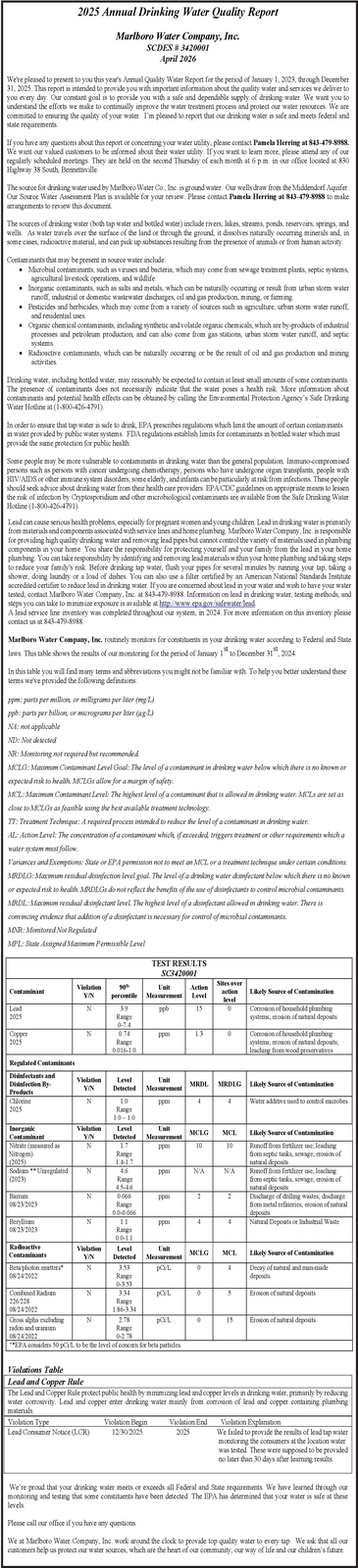
2025 Annual Drinking Water Quality Report Marlboro Water Company, Inc. SCDES # 3420001 April 2026 We're pleased to present to you this year's Annual Quality Water Report for the period of January 1, 2023, through December 31, 2025. This report is intended to provide you with important information about the quality water and services we deliver to you every day. Our constant goal is to provide you with a safe and dependable supply of drinking water. We want you to understand the efforts we make to continually improve the water treatment process and protect our water resources. We are committed to ensuring the quality of your water. I'm pleased to report that our drinking water is safe and meets federal and state requirements If you have any questions about this report or concerning your water utility, please contact Pamela Herring at 843-479-8988. We want our valued customers to be informed about their water utility. If you want to learn more, please attend any of our regularly scheduled meetings. They are held on the second Thursday of each month at 6 p.m. in our office located at 830 Highway 38 South, Bennettsville. The source for drinking water used by Marlboro Water Co., Inc. is ground water. Our wells draw from the Middendorf Aquifer Our Source Water Assessment Plan is available for your review. Please contact Pamela Herring at 843-479-8988 to make arrangements to review this document The sources of drinking water (both tap water and bottled water) include rivers, lakes, streams, ponds, reservoirs, springs, and wells. As water travels over the surface of the land or through the ground, it dissolves naturally occurring minerals and, in some cases, radioactive material, and can pick up substances resulting from the presence of animals ce from human activity. Contaminants that may be present in source water include: Microbial contaminants, such as viruses and bacteria, which may come from sewage treatment plants, septic systems, agricultural livestock operations, and wildlife. Inorganic contaminants, such as salts and metals, which can be naturally occurring or result from urban storm water runoff, industrial or domestic wastewater discharges, oil and gas production, mining, or farming Pesticides and herbicides, which may come from a variety of sources such as agriculture, urban storm water runoff, and residential uses Organic chemical contaminants, including synthetic and volatile organic chemicals, which are by-products of industrial processes and petroleum production, and can also come from gas stations, urban storm water runoff, and septic systems Radioactive contaminants, which can be naturally occurring or be the result of oil and gas production and mining activities Drinking water, including bottled water, may reasonably be expected to contain at least small amounts of some contaminants The presence of contaminants does not necessarily indicate that the water poses a health risk More information about contaminants and potential health effects can be obtained by calling the Environmental Protection Agency's Safe Drinking Water Hotline at (1-800-426-4791). In order to ensure that tap water is safe to drink, EPA prescribes regulations which limit the amount of certain contaminants in water provided by public water systems. FDA regulations establish limits for contaminants in bottled water which must provide the same protection for public health Some people may be more vulnerable to contaminants in drinking water than the general population. Immuno-compromised persons such as persons with cancer undergoing chemotherapy, persons who have undergone organ transplants, people with HIV/AIDS or other immune system disorders, some elderly, and infants can be particularly at risk from infections. These people should seek advice about drinking water from their health care providers. EPA/CDC guidelines on appropriate means to lessen the risk of infection by Cryptosporidium and other microbiological contaminants are available from the Safe Drinking Water Hotline (1-800-426-4791) Lead can cause serious health problems, especially for pregnant women and young children Lead in drinking water is primarily from materials and components associated with service lines and home plumbing Marlboro Water Company, Inc. is responsible for providing high quality drinking water and removing lead pipes but cannot control the variety of materials used in plumbing components in your home. You share the responsibility for protecting yourself and your family from the lead in your home plumbing. You can take responsibility by identifying and removing lead materials within your home plumbing and taking steps to reduce your family's risk. Before drinking tap water, flush your pipes for several minutes by running your tap, taking a shower, doing laundry or a load of dishes. You can also use a filter certified by an American National Standards Institute accredited certifier to reduce lead in drinking water. If you are concerned about lead in your water and wish to have your water tested, contact Marlboro Water Company, Inc. at 843-479-8988. Information on lead in drinking water, testing methods, and steps you can take to minimize exposure is available at http://www.epa.gov/safewater lead A lead service line inventory was completed throughout our system, in 2024. For more information on this inventory please contact us at 843-479-8988 Marlboro Water Company, Inc. routinely monitors for constituents in your drinking water according to Federal and State laws. This table shows the results of our monitoring for the period of January 1 to December 31, 2004 In this table you will find many terms and abbreviations you might not be familiar with. To help you better understand these terms we've provided the following definitions: ppm: parts per million, or milligrams per liter (mg) ppb: parts per billion, or micrograms per liter (ug..) NA: not applicable ND: Not detected NR: Monitoring not required but recommended MCLG: Maximum Contaminant Level Goal: The level of a contaminant in drinking water below which there is no known or expected risk to health MCLGs allow for a margin of safety. MCL: Marimon Contaminant Level: The highest level of a contaminant that is allowed in drinking water. MCLs are set as close to MCLGs as feasible using the best available treatment technology. TT: Treatment Technique: A required process intended to reduce the level of a contaminant in drinking water. AL: Action Level: The concentration of a contaminant which if exceeded, triggers treatment or other requirements which a water system must follow. Variances and Exemptions: State or EPA permission not to meet an MCL or a treatment technique under certain conditions. MRDLG: Maximum residual disinfection level goal. The level of a drinking water disinfectant below which there is no known or expected risk to health MRDLGs do not reflect the benefits of the use of disinfectants to control microbial contaminants. MRDL: Maximum residual disinfectant level. The highest level of a disinfectant allowed in drinking water. There is convincing evidence that addition of a disinfectant is necessary for control of microbial contaminants. MNR: Monitored Not Regulated MPL: State Assigned Maxim Permissible Level TEST RESULTS SC3420001 Unit Action Sites over action YIN percentile Measurement Likely Source of Contamination N 39 ppb ° Corrosion of household plumbing Range systems, erosion of natural deposits 0-74 N 0.74 13 ° Corrosion of household plumbing Range systems, erosion of natural deposits, leaching from wood preservatives Violation Contaminant Lead 2025 Copper 2025 Regulated Contaminants Didnfectants and Didnfection By Products Chlorine 2025 Violation Level YN Unit Detected Measurement MRDL MRDLG Likely Source of Contamination 4 Water additive used to control microbes Inorganic Contaminant Range 1.0-1.0 Violation Level YIN Nitrate (manda N Unit Detected Measurement MCLG 10 Likely Source of Contamination 10 Runoff from fertilizers, leaching Nitrogm) (2025) Range 14-17 from septic tanks, sewage, erosion of natural deposits Sodem Unregulated N 46 ppm N/A N/A Runoff from fertilizer lang (2023) Range from septic tanks, sewage, osion of 45-46 natural deposits N ppm 2 2 Discharge of drilling wastes, discharge 08/23/2023 Range 0.0-0.066 from metal refineries, mosion of natural deposits Beryllian N 4 4 Natural Deposits or Industrial Waste 08/23/2023 Range Radioactive 0.0-1.1 Violation Level Contaminants YIN Beta photon matters N Unit Detected Measurement 3.53 MCLG MCL Likely Source of Contamination PC/L 0 4 08/24/2022 Range Decay of natural and man-made deposit 0-3.53 Combined Radium N 3.34 POL ° 5 Erosion of natural deposits 226/228 Range 08/24/2022 1.86-3.34 Gross alpha excluding N 2.78 POL 0 15 Erosion of natural depouts radon and anim Range 08/24/2012 0-2.78 **EPA considers 50 pCV to be the level of concern for beta particles Violations Table Lead and Copper Rule The Lead and Copper Rule protect public health by minimizing lead and copper levels in drinking water, primarily by reducing water corrosivity. Lead and copper enter drinking water mainly from corrosion of lead and copper containing plumbing materials Violation Type Lead Consumer Notice (LCR) Violation Begin 12/30/2025 Violation End Violation Explanation 2025 We failed to provide the results of lead tap water monitoring the consumers at the location water was tested. These were supposed to be p be provided no later than 30 days after learning results We're proud that your drinking water meets or exceeds all Federal and State requirements. We have learned through our monitoring and testing that some constituents have been detected. The EPA has determined that your water is safe at these levels Please call our office if you have any questions We at Marlboro Water Company, Inc. work around the clock to provide top quality water to every tap. We ask that all our customers help us protect our water sources, which are the heart of our community, our way of life and our children's future. 2025 Annual Drinking Water Quality Report Marlboro Water Company , Inc. SCDES # 3420001 April 2026 We're pleased to present to you this year's Annual Quality Water Report for the period of January 1 , 2023 , through December 31 , 2025. This report is intended to provide you with important information about the quality water and services we deliver to you every day . Our constant goal is to provide you with a safe and dependable supply of drinking water . We want you to understand the efforts we make to continually improve the water treatment process and protect our water resources . We are committed to ensuring the quality of your water . I'm pleased to report that our drinking water is safe and meets federal and state requirements If you have any questions about this report or concerning your water utility , please contact Pamela Herring at 843-479-8988 . We want our valued customers to be informed about their water utility . If you want to learn more , please attend any of our regularly scheduled meetings . They are held on the second Thursday of each month at 6 p.m. in our office located at 830 Highway 38 South , Bennettsville . The source for drinking water used by Marlboro Water Co. , Inc. is ground water . Our wells draw from the Middendorf Aquifer Our Source Water Assessment Plan is available for your review . Please contact Pamela Herring at 843-479-8988 to make arrangements to review this document The sources of drinking water ( both tap water and bottled water ) include rivers , lakes , streams , ponds , reservoirs , springs , and wells . As water travels over the surface of the land or through the ground , it dissolves naturally occurring minerals and , in some cases , radioactive material , and can pick up substances resulting from the presence of animals ce from human activity . Contaminants that may be present in source water include : Microbial contaminants , such as viruses and bacteria , which may come from sewage treatment plants , septic systems , agricultural livestock operations , and wildlife . Inorganic contaminants , such as salts and metals , which can be naturally occurring or result from urban storm water runoff , industrial or domestic wastewater discharges , oil and gas production , mining , or farming Pesticides and herbicides , which may come from a variety of sources such as agriculture , urban storm water runoff , and residential uses Organic chemical contaminants , including synthetic and volatile organic chemicals , which are by - products of industrial processes and petroleum production , and can also come from gas stations , urban storm water runoff , and septic systems Radioactive contaminants , which can be naturally occurring or be the result of oil and gas production and mining activities Drinking water , including bottled water , may reasonably be expected to contain at least small amounts of some contaminants The presence of contaminants does not necessarily indicate that the water poses a health risk More information about contaminants and potential health effects can be obtained by calling the Environmental Protection Agency's Safe Drinking Water Hotline at ( 1-800-426-4791 ) . In order to ensure that tap water is safe to drink , EPA prescribes regulations which limit the amount of certain contaminants in water provided by public water systems . FDA regulations establish limits for contaminants in bottled water which must provide the same protection for public health Some people may be more vulnerable to contaminants in drinking water than the general population . Immuno - compromised persons such as persons with cancer undergoing chemotherapy , persons who have undergone organ transplants , people with HIV / AIDS or other immune system disorders , some elderly , and infants can be particularly at risk from infections . These people should seek advice about drinking water from their health care providers . EPA / CDC guidelines on appropriate means to lessen the risk of infection by Cryptosporidium and other microbiological contaminants are available from the Safe Drinking Water Hotline ( 1-800-426-4791 ) Lead can cause serious health problems , especially for pregnant women and young children Lead in drinking water is primarily from materials and components associated with service lines and home plumbing Marlboro Water Company , Inc. is responsible for providing high quality drinking water and removing lead pipes but cannot control the variety of materials used in plumbing components in your home . You share the responsibility for protecting yourself and your family from the lead in your home plumbing . You can take responsibility by identifying and removing lead materials within your home plumbing and taking steps to reduce your family's risk . Before drinking tap water , flush your pipes for several minutes by running your tap , taking a shower , doing laundry or a load of dishes . You can also use a filter certified by an American National Standards Institute accredited certifier to reduce lead in drinking water . If you are concerned about lead in your water and wish to have your water tested , contact Marlboro Water Company , Inc. at 843-479-8988 . Information on lead in drinking water , testing methods , and steps you can take to minimize exposure is available at http://www.epa.gov/safewater lead A lead service line inventory was completed throughout our system , in 2024. For more information on this inventory please contact us at 843-479-8988 Marlboro Water Company , Inc. routinely monitors for constituents in your drinking water according to Federal and State laws . This table shows the results of our monitoring for the period of January 1 to December 31 , 2004 In this table you will find many terms and abbreviations you might not be familiar with . To help you better understand these terms we've provided the following definitions : ppm : parts per million , or milligrams per liter ( mg ) ppb : parts per billion , or micrograms per liter ( ug .. ) NA : not applicable ND : Not detected NR : Monitoring not required but recommended MCLG : Maximum Contaminant Level Goal : The level of a contaminant in drinking water below which there is no known or expected risk to health MCLGs allow for a margin of safety . MCL : Marimon Contaminant Level : The highest level of a contaminant that is allowed in drinking water . MCLs are set as close to MCLGs as feasible using the best available treatment technology . TT : Treatment Technique : A required process intended to reduce the level of a contaminant in drinking water . AL : Action Level : The concentration of a contaminant which if exceeded , triggers treatment or other requirements which a water system must follow . Variances and Exemptions : State or EPA permission not to meet an MCL or a treatment technique under certain conditions . MRDLG : Maximum residual disinfection level goal . The level of a drinking water disinfectant below which there is no known or expected risk to health MRDLGs do not reflect the benefits of the use of disinfectants to control microbial contaminants . MRDL : Maximum residual disinfectant level . The highest level of a disinfectant allowed in drinking water . There is convincing evidence that addition of a disinfectant is necessary for control of microbial contaminants . MNR : Monitored Not Regulated MPL : State Assigned Maxim Permissible Level TEST RESULTS SC3420001 Unit Action Sites over action YIN percentile Measurement Likely Source of Contamination N 39 ppb ° Corrosion of household plumbing Range systems , erosion of natural deposits 0-74 N 0.74 13 ° Corrosion of household plumbing Range systems , erosion of natural deposits , leaching from wood preservatives Violation Contaminant Lead 2025 Copper 2025 Regulated Contaminants Didnfectants and Didnfection By Products Chlorine 2025 Violation Level YN Unit Detected Measurement MRDL MRDLG Likely Source of Contamination 4 Water additive used to control microbes Inorganic Contaminant Range 1.0-1.0 Violation Level YIN Nitrate ( manda N Unit Detected Measurement MCLG 10 Likely Source of Contamination 10 Runoff from fertilizers , leaching Nitrogm ) ( 2025 ) Range 14-17 from septic tanks , sewage , erosion of natural deposits Sodem Unregulated N 46 ppm N / A N / A Runoff from fertilizer lang ( 2023 ) Range from septic tanks , sewage , osion of 45-46 natural deposits N ppm 2 2 Discharge of drilling wastes , discharge 08/23/2023 Range 0.0-0.066 from metal refineries , mosion of natural deposits Beryllian N 4 4 Natural Deposits or Industrial Waste 08/23/2023 Range Radioactive 0.0-1.1 Violation Level Contaminants YIN Beta photon matters N Unit Detected Measurement 3.53 MCLG MCL Likely Source of Contamination PC / L 0 4 08/24/2022 Range Decay of natural and man - made deposit 0-3.53 Combined Radium N 3.34 POL ° 5 Erosion of natural deposits 226/228 Range 08/24/2022 1.86-3.34 Gross alpha excluding N 2.78 POL 0 15 Erosion of natural depouts radon and anim Range 08/24/2012 0-2.78 ** EPA considers 50 pCV to be the level of concern for beta particles Violations Table Lead and Copper Rule The Lead and Copper Rule protect public health by minimizing lead and copper levels in drinking water , primarily by reducing water corrosivity . Lead and copper enter drinking water mainly from corrosion of lead and copper containing plumbing materials Violation Type Lead Consumer Notice ( LCR ) Violation Begin 12/30/2025 Violation End Violation Explanation 2025 We failed to provide the results of lead tap water monitoring the consumers at the location water was tested . These were supposed to be p be provided no later than 30 days after learning results We're proud that your drinking water meets or exceeds all Federal and State requirements . We have learned through our monitoring and testing that some constituents have been detected . The EPA has determined that your water is safe at these levels Please call our office if you have any questions We at Marlboro Water Company , Inc. work around the clock to provide top quality water to every tap . We ask that all our customers help us protect our water sources , which are the heart of our community , our way of life and our children's future .