
Advertisement
-
Published Date
May 21, 2026This ad was originally published on this date and may contain an offer that is no longer valid. To learn more about this business and its most recent offers, click here.
Ad Text
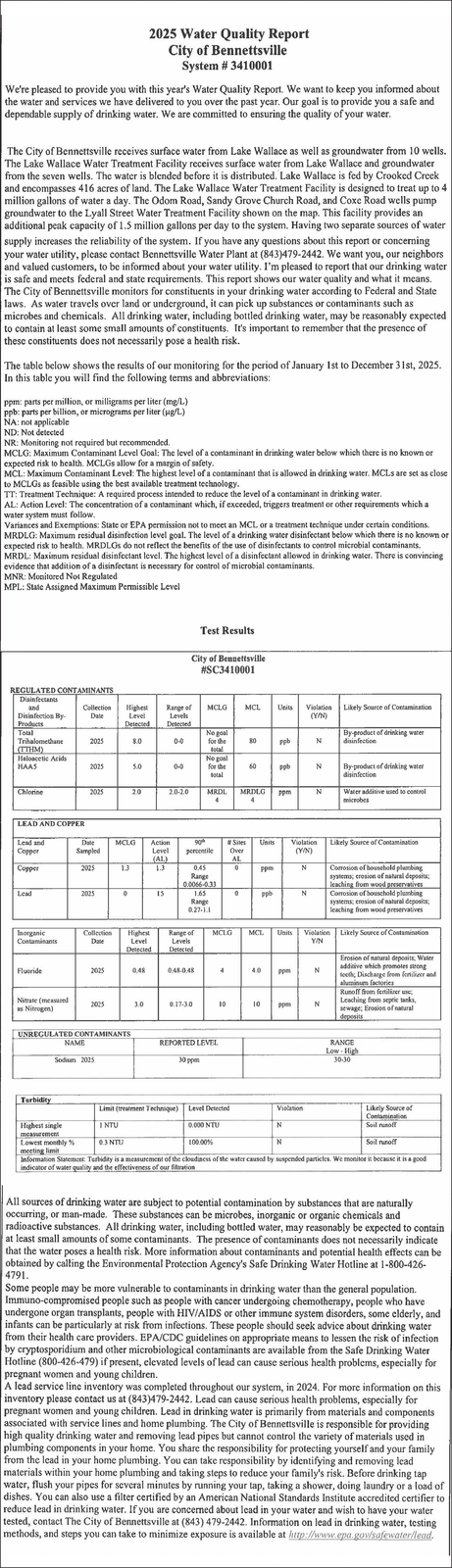
2025 Water Quality Report City of Bennettsville System # 3410001 We're pleased to provide you with this year's Water Quality Report. We want to keep you informed about the water and services we have delivered to you over the past year. Our goal is to provide you a safe and dependable supply of drinking water. We are committed to ensuring the quality of your water. The City of Bennettsville receives surface water from Lake Wallace as well as groundwater from 10 wells. The Lake Wallace Water Treatment Facility receives surface water from Lake Wallace and groundwater from the seven wells. The water is blended before it is distributed. Lake Wallace is fed by Crooked Creek and encompasses 416 acres of land. The Lake Wallace Water Treatment Facility is designed to treat up to 4 million gallons of water a day. The Odom Road, Sandy Grove Church Road, and Coxe Road wells pump groundwater to the Lyall Street Water Treatment Facility shown on the map. This facility provides an additional peak capacity of 1.5 million gallons per day to the system. Having two separate sources of water supply increases the reliability of the system. If you have any questions about this report or concerning your water utility, please contact Bennettsville Water Plant at (843)479-2442. We want you, our neighbors and valued customers, to be informed about your water utility. I'm pleased to report that our drinking water is safe and meets federal and state requirements. This report shows our water quality and what it means. The City of Bennettsville monitors for constituents in your drinking water according to Federal and State laws. As water travels over land or underground, it can pick up substances or contaminants such as microbes and chemicals. All drinking water, including bottled drinking water, may be reasonably expected to contain at least some small amounts of constituents. It's important to remember that the presence of these constituents does not necessarily pose a health risk. The table below shows the results of our monitoring for the period of January 1st to December 31st, 2025. In this table you will find the following terms and abbreviations: ppm: parts per million, or milligrams per liter (mg/L) ppb: parts per billion, or micrograms per liter (µg/L) NA: not applicable ND: Not detected NR: Monitoring not required but recommended. MCLG: Maximum Contaminant Level Goal: The level of a contaminant in drinking water below which there is no known or expected risk to health. MCLGs allow for a margin of safety. MCL: Maximum Contaminant Level: The highest level of a contaminant that is allowed in drinking water. MCLs are set as close to MCLGs as feasible using the best available treatment technology. TT: Treatment Technique: A required process intended to reduce the level of a contaminant in drinking water. AL: Action Level: The concentration of a contaminant which, if exceeded, triggers treatment or other requirements which a water system must follow. Variances and Exemptions: State or EPA permission not to meet an MCL or a treatment technique under certain conditions. MRDLG: Maximum residual disinfection level goal. The level of a drinking water disinfectant below which there is no known or expected risk to health. MRDLGs do not reflect the benefits of the use of disinfectants to control microbial contaminants. MRDL: Maximum residual disinfectant level. The highest level of a disinfectant allowed in drinking water. There is convincing evidence that addition of a disinfectant is necessary for control of microbial contaminants. MNR: Monitored Not Regulated MPL: State Assigned Maximum Permissible Level REGULATED CONTAMINANTS Test Results City of Bennettsville #SC3410001 Disinfectants Collection Highest Disinfection By Date Products Level Detected Range of Levels Detected MCLG MCL Units Violation (Y/N) Likely Source of Contamination No goal Trihalomethane 2025 8.0 0-0 80 ppb N By-product of drinking water disinfection TTHM) Haloacetic Acids No goal HAAS 2025 5.0 for the total 60 N By-product of drinking water disinfection Chlorine 2025 20 MRDL MRDLG ppm N Water additive used to control microbes LEAD AND COPPER Lead and Copper Date Sampled MCLG 90% #Sites Units percentile Over Violation (Y/N) Likely Source of Contamination (AL) AL Copper 2025 1.3 1.3 0.45 0 Ppm N Corrosion of household plumbing Range 0.0066-0.33 Lead 2025 0 ppb N Range 0.27-1.1 systems; erosion of natural deposits; leaching from wood preservatives Corrosion of household plumbing systems; erosion of natural deposits; leaching from wood preservatives Inorganic Contaminants Collection Highest Date Level Detected Range of Levels Detected MCLG MCL Units Violation Likely Source of Contamination Fluoride 2025 0.48 0.45-0.48 4 40 Nitrate (measured as Nitrogen) 3.0 0.17-30 10 10 pp N sewage; Erosion of natural Y/N Erosion of natural deposits, Water additive which promotes strong teeth, Discharge from fertilizer and aluminum factories Runoff from fertilizer use Leaching from septic tanks, UNREGULATED CONTAMINANTS NAME Sodium 2025 REPORTED LEVEL 30ppm deposits RANGE Low-High 30-30 Turbidity Limit (treatment Technique) Level Detected Violation Highest single 0.000 NTU measurement Lowest monthly% 03 NTU 100.00% N meeting limit Likely Source of Contamination Soil nunoff Soil runoff Information Statement: Turbidity is a measurement of the cloudiness of the water caused by suspended particles. We monitor it because it is a good indicator of water quality and the effectiveness of our filtration All sources of drinking water are subject to potential contamination by substances that are naturally occurring, or man-made. These substances can be microbes, inorganic or organic chemicals and radioactive substances. All drinking water, including bottled water, may reasonably be expected to contain at least small amounts of some contaminants. The presence of contaminants does not necessarily indicate that the water poses a health risk. More information about contaminants and potential health effects can be obtained by calling the Environmental Protection Agency's Safe Drinking Water Hotline at 1-800-426- 4791. Some people may be more vulnerable to contaminants in drinking water than the general population. Immuno-compromised people such as people with cancer undergoing chemotherapy, people who have undergone organ transplants, people with HIV/AIDS or other immune system disorders, some elderly, and infants can be particularly at risk from infections. These people should seek advice about drinking water from their health care providers. EPA/CDC guidelines on appropriate means to lessen the risk of infection by cryptosporidium and other microbiological contaminants are available from the Safe Drinking Water Hotline (800-426-479) if present, elevated levels of lead can cause serious health problems, especially for pregnant women and young children. A lead service line inventory was completed throughout our system, in 2024. For more information on this inventory please contact us at (843)479-2442. Lead can cause serious health problems, especially for pregnant women and young children. Lead in drinking water is primarily from materials and components associated with service lines and home plumbing. The City of Bennettsville is responsible for providing high quality drinking water and removing lead pipes but cannot control the variety of materials used in plumbing components in your home. You share the responsibility for protecting yourself and your family from the lead in your home plumbing. You can take responsibility by identifying and removing lead materials within your home plumbing and taking steps to reduce your family's risk. Before drinking tap water, flush your pipes for several minutes by running your tap, taking a shower, doing laundry or a load of dishes. You can also use a filter certified by an American National Standards Institute accredited certifier to reduce lead in drinking water. If you are concerned about lead in your water and wish to have your water tested, contact The City of Bennettsville at (843) 479-2442. Information on lead in drinking water, testing methods, and steps you can take to minimize exposure is available at http://www.epa.gov/safewater/lead. 2025 Water Quality Report City of Bennettsville System # 3410001 We're pleased to provide you with this year's Water Quality Report . We want to keep you informed about the water and services we have delivered to you over the past year . Our goal is to provide you a safe and dependable supply of drinking water . We are committed to ensuring the quality of your water . The City of Bennettsville receives surface water from Lake Wallace as well as groundwater from 10 wells . The Lake Wallace Water Treatment Facility receives surface water from Lake Wallace and groundwater from the seven wells . The water is blended before it is distributed . Lake Wallace is fed by Crooked Creek and encompasses 416 acres of land . The Lake Wallace Water Treatment Facility is designed to treat up to 4 million gallons of water a day . The Odom Road , Sandy Grove Church Road , and Coxe Road wells pump groundwater to the Lyall Street Water Treatment Facility shown on the map . This facility provides an additional peak capacity of 1.5 million gallons per day to the system . Having two separate sources of water supply increases the reliability of the system . If you have any questions about this report or concerning your water utility , please contact Bennettsville Water Plant at ( 843 ) 479-2442 . We want you , our neighbors and valued customers , to be informed about your water utility . I'm pleased to report that our drinking water is safe and meets federal and state requirements . This report shows our water quality and what it means . The City of Bennettsville monitors for constituents in your drinking water according to Federal and State laws . As water travels over land or underground , it can pick up substances or contaminants such as microbes and chemicals . All drinking water , including bottled drinking water , may be reasonably expected to contain at least some small amounts of constituents . It's important to remember that the presence of these constituents does not necessarily pose a health risk . The table below shows the results of our monitoring for the period of January 1st to December 31st , 2025 . In this table you will find the following terms and abbreviations : ppm : parts per million , or milligrams per liter ( mg / L ) ppb : parts per billion , or micrograms per liter ( µg / L ) NA : not applicable ND : Not detected NR : Monitoring not required but recommended . MCLG : Maximum Contaminant Level Goal : The level of a contaminant in drinking water below which there is no known or expected risk to health . MCLGs allow for a margin of safety . MCL : Maximum Contaminant Level : The highest level of a contaminant that is allowed in drinking water . MCLs are set as close to MCLGs as feasible using the best available treatment technology . TT : Treatment Technique : A required process intended to reduce the level of a contaminant in drinking water . AL : Action Level : The concentration of a contaminant which , if exceeded , triggers treatment or other requirements which a water system must follow . Variances and Exemptions : State or EPA permission not to meet an MCL or a treatment technique under certain conditions . MRDLG : Maximum residual disinfection level goal . The level of a drinking water disinfectant below which there is no known or expected risk to health . MRDLGs do not reflect the benefits of the use of disinfectants to control microbial contaminants . MRDL : Maximum residual disinfectant level . The highest level of a disinfectant allowed in drinking water . There is convincing evidence that addition of a disinfectant is necessary for control of microbial contaminants . MNR : Monitored Not Regulated MPL : State Assigned Maximum Permissible Level REGULATED CONTAMINANTS Test Results City of Bennettsville # SC3410001 Disinfectants Collection Highest Disinfection By Date Products Level Detected Range of Levels Detected MCLG MCL Units Violation ( Y / N ) Likely Source of Contamination No goal Trihalomethane 2025 8.0 0-0 80 ppb N By - product of drinking water disinfection TTHM ) Haloacetic Acids No goal HAAS 2025 5.0 for the total 60 N By - product of drinking water disinfection Chlorine 2025 20 MRDL MRDLG ppm N Water additive used to control microbes LEAD AND COPPER Lead and Copper Date Sampled MCLG 90 % #Sites Units percentile Over Violation ( Y / N ) Likely Source of Contamination ( AL ) AL Copper 2025 1.3 1.3 0.45 0 Ppm N Corrosion of household plumbing Range 0.0066-0.33 Lead 2025 0 ppb N Range 0.27-1.1 systems ; erosion of natural deposits ; leaching from wood preservatives Corrosion of household plumbing systems ; erosion of natural deposits ; leaching from wood preservatives Inorganic Contaminants Collection Highest Date Level Detected Range of Levels Detected MCLG MCL Units Violation Likely Source of Contamination Fluoride 2025 0.48 0.45-0.48 4 40 Nitrate ( measured as Nitrogen ) 3.0 0.17-30 10 10 pp N sewage ; Erosion of natural Y / N Erosion of natural deposits , Water additive which promotes strong teeth , Discharge from fertilizer and aluminum factories Runoff from fertilizer use Leaching from septic tanks , UNREGULATED CONTAMINANTS NAME Sodium 2025 REPORTED LEVEL 30ppm deposits RANGE Low - High 30-30 Turbidity Limit ( treatment Technique ) Level Detected Violation Highest single 0.000 NTU measurement Lowest monthly % 03 NTU 100.00 % N meeting limit Likely Source of Contamination Soil nunoff Soil runoff Information Statement : Turbidity is a measurement of the cloudiness of the water caused by suspended particles . We monitor it because it is a good indicator of water quality and the effectiveness of our filtration All sources of drinking water are subject to potential contamination by substances that are naturally occurring , or man - made . These substances can be microbes , inorganic or organic chemicals and radioactive substances . All drinking water , including bottled water , may reasonably be expected to contain at least small amounts of some contaminants . The presence of contaminants does not necessarily indicate that the water poses a health risk . More information about contaminants and potential health effects can be obtained by calling the Environmental Protection Agency's Safe Drinking Water Hotline at 1-800-426- 4791 . Some people may be more vulnerable to contaminants in drinking water than the general population . Immuno - compromised people such as people with cancer undergoing chemotherapy , people who have undergone organ transplants , people with HIV / AIDS or other immune system disorders , some elderly , and infants can be particularly at risk from infections . These people should seek advice about drinking water from their health care providers . EPA / CDC guidelines on appropriate means to lessen the risk of infection by cryptosporidium and other microbiological contaminants are available from the Safe Drinking Water Hotline ( 800-426-479 ) if present , elevated levels of lead can cause serious health problems , especially for pregnant women and young children . A lead service line inventory was completed throughout our system , in 2024. For more information on this inventory please contact us at ( 843 ) 479-2442 . Lead can cause serious health problems , especially for pregnant women and young children . Lead in drinking water is primarily from materials and components associated with service lines and home plumbing . The City of Bennettsville is responsible for providing high quality drinking water and removing lead pipes but cannot control the variety of materials used in plumbing components in your home . You share the responsibility for protecting yourself and your family from the lead in your home plumbing . You can take responsibility by identifying and removing lead materials within your home plumbing and taking steps to reduce your family's risk . Before drinking tap water , flush your pipes for several minutes by running your tap , taking a shower , doing laundry or a load of dishes . You can also use a filter certified by an American National Standards Institute accredited certifier to reduce lead in drinking water . If you are concerned about lead in your water and wish to have your water tested , contact The City of Bennettsville at ( 843 ) 479-2442 . Information on lead in drinking water , testing methods , and steps you can take to minimize exposure is available at http://www.epa.gov/safewater/lead .